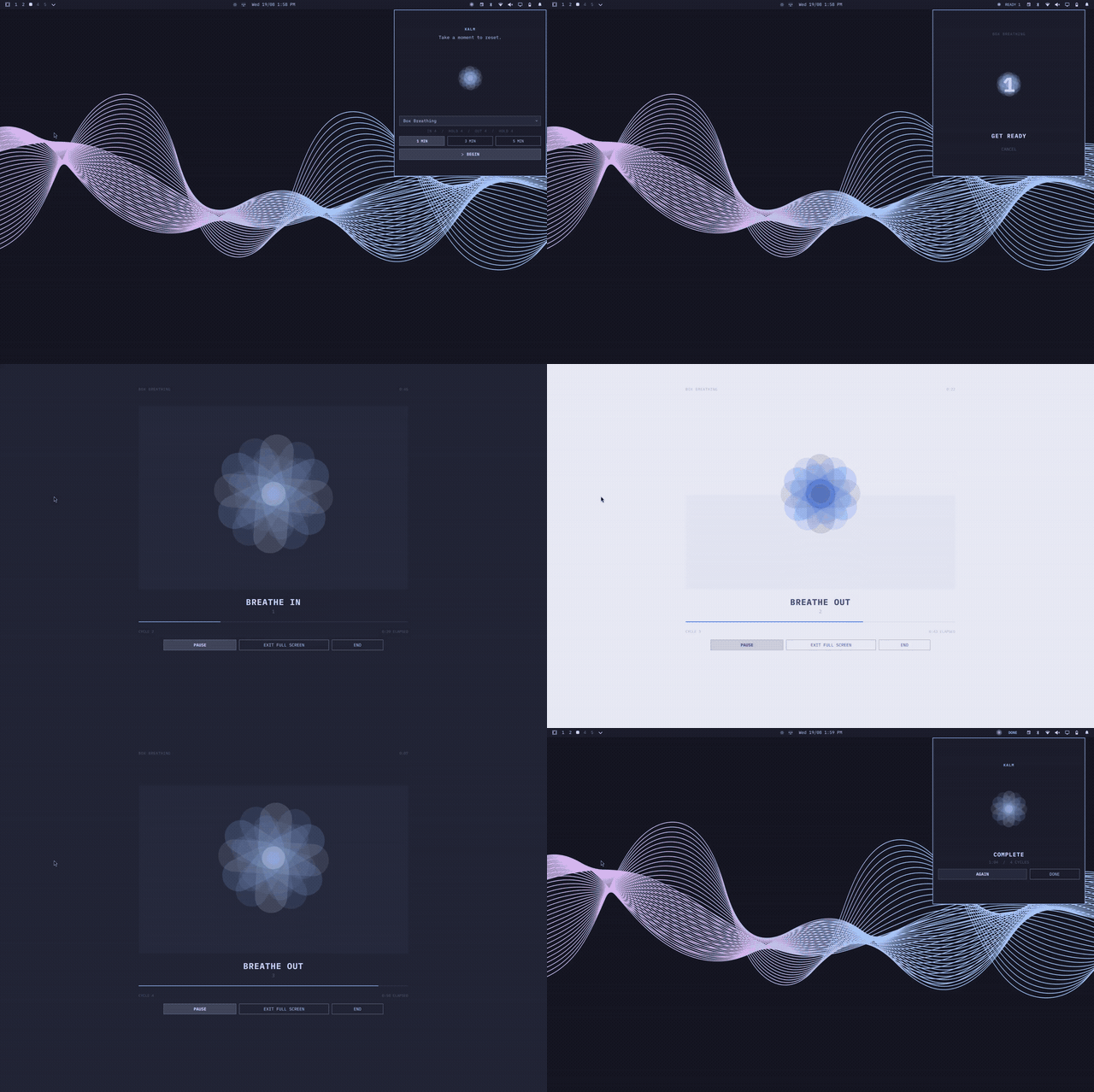
I’ve been spending a probably unreasonable amount of time playing with Omarchy since the release of Omarchy 4, and the thing I keep coming back to is how much fun it is to build little things for it.
If you haven’t followed Omarchy, it’s a Linux distribution built around Arch, Hyprland, and, as of Omarchy 4, Quickshell. The important change in the new release is that most of the desktop itself—the menu bar, panels, notifications, menus, overlays, lock screen, and a lot more—now lives inside one Quickshell environment with a proper plugin system.
That sounds like an implementation detail, but I think it changes the relationship you can have with your computer.
The desktop is suddenly malleable.
Instead of thinking about the operating system as this finished thing handed down to you by Apple, Microsoft, or even whoever built your Linux distribution, it starts to feel more like a collection of parts you can rearrange, modify, replace, or add to.
And agents make that considerably more interesting.
“I wish my computer did this”#
Traditionally, customizing Linux has meant being willing to spend a Saturday reading documentation, editing configuration files, searching Stack Overflow, breaking something, fixing it, and eventually convincing yourself that the six hours were worth saving two keystrokes.
There is admittedly a certain charm to that.
But coding agents change the economics of tiny software.
With Omarchy, I can have an idea for something I wish existed in my operating system, describe it to an agent, and start iterating on a working version almost immediately.
Omarchy's plugin system is particularly well suited to this. A plugin can add a widget to the bar, open a panel, create a fullscreen overlay, run a background service, add a menu, or even replace the bar itself. Plugins are basically a manifest plus QML, and changes reload automatically while you're working on them.
More importantly, they live inside the same shell as everything else.
That means something you create doesn't necessarily have to feel like another random application floating around your desktop. It can use the same theme, colors, interaction patterns, panels, and surfaces as the rest of the OS.
So the conversation with an agent can become surprisingly high level:
Put this in my menu bar.
Make the panel behave like the other Omarchy panels.
Use my current theme colors.
Give me a keyboard shortcut.
Make this fullscreen.
That animation feels weird. Slow it down.
And a few iterations later, your computer has a new feature.
I think that's a pretty profound shift.
My first experiment: Kalm#
The first plugin I built this way is called Kalm.
The idea was extremely simple: I missed the guided breathing experience from Apple's Breathe/Mindfulness apps and wondered what that might look like if it were simply part of Omarchy.
So I made it part of Omarchy.
Kalm sits quietly in the menu bar as a little flower. Click it and you can choose a breathing technique and a one-, three-, or five-minute session. When you start, the flower expands and contracts with your breathing. There's also a fullscreen mode if you want everything else to disappear for a minute.
It supports a handful of different techniques—box breathing, resonant breathing, 4-7-8, alternate-nostril breathing, and others—and the animation automatically picks up the colors of whatever Omarchy theme I'm currently using.
It's a tiny piece of software.
And that's sort of the point.
I probably wouldn't have gone looking for a standalone Linux application to solve this. I definitely wouldn't have started a traditional software project around it.
I just wanted my computer to do a thing.
Now it does.
Software gets a lot smaller from here#
This is the part of agents that I find considerably more interesting than generating another SaaS application.
There are thousands of tiny pieces of software that probably never made economic sense to build. Things that are useful to one person, or fifty people, or people with some oddly specific workflow.
When the cost of creating those things approaches the cost of describing them, a lot more of them are going to exist.
And an open, programmable operating system is an unusually interesting place for that to happen.
Instead of every idea becoming another app, another account, another Electron window, another subscription, or another tab in Chrome, some ideas can just become features of your computer.
I've already found myself thinking differently because of this.
I don't immediately search for an app anymore.
Sometimes I just think:
Could I add this to Omarchy?
Increasingly, the answer is yes.
That's been a lot of fun.
And I suspect Kalm is going to be the first of many little things I build for my computer simply because I want them to exist.